
RSBQQuébec Building Health NetworkVerify a company

Drinking water and building plumbing

Water quality: from the source to the tap

Clear water with no unusual taste or odour is not necessarily free of contaminants. The assessment links the supply, building plumbing, treatment devices and a sample collected at the right place and time.

RSBQ professional fieldwork — Drinking water and building plumbing

Understand the supply system

The profile distinguishes a municipal system, private well or other supply. For a well, the owner is responsible for water quality and only regular analysis by an accredited laboratory can establish its condition.

  • Well type, depth and condition
  • Distance from possible contamination sources
  • Flooding or work history
  • Treatment, filters and maintenance
  • Tank, water heater and interior plumbing

Select analyses based on risk

The minimum program is adapted to context. Microbiological, inorganic, organic and radiological parameters are not all triggered in the same way.

  • Indicator bacteria
  • Nitrate and nitrite
  • Metals, including lead where plumbing warrants
  • Minerals and aesthetic parameters
  • Contaminants related to nearby activities
  • Before-and-after treatment samples where relevant

Preserve traceability

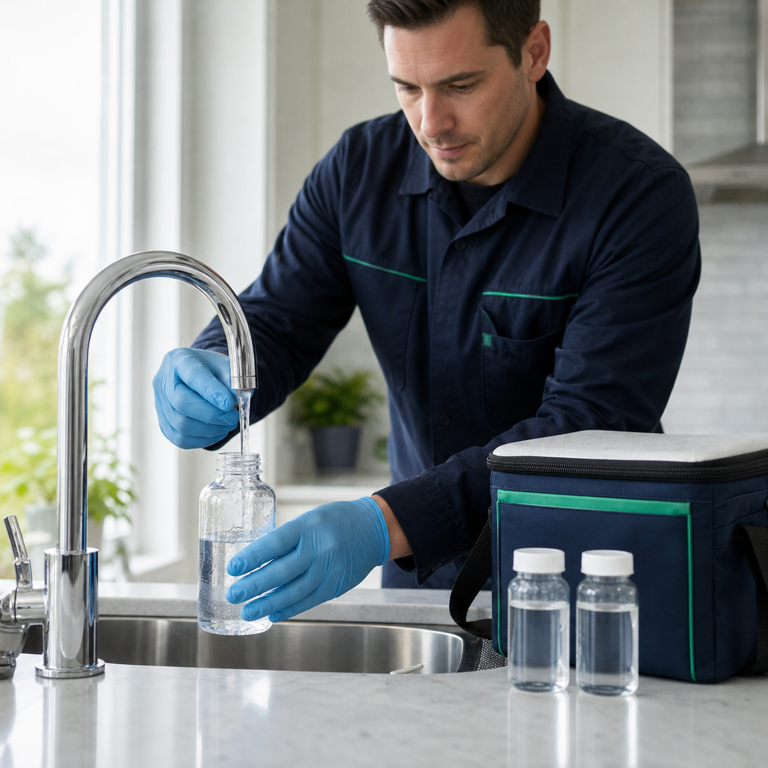
Sampling point, stagnation, flushing, preservation and transport time can change the result. These conditions are recorded with the laboratory report.

  • Laboratory bottles and instructions
  • Exact date, time and point
  • Tap and treatment conditions
  • Chain of custody
  • Interpretation under applicable guidance

RSBQ field guide · Water and lead

Questions a serious file should answer.

Context determines the method. These guideposts help distinguish a structured investigation from a simple collection of results.

01

What is the water source?

Municipal supply, well, private treatment, tank or building system.

02

Which scenario is assessed?

Consumption, stagnation, plumbing, corrosion, microbiology or post-work contamination.

03

Does the sampling protocol fit?

Tap, stagnation, flushing, container, preservation and laboratory affect the result.

04

What action follows?

Notice, flushing, treatment, plumbing correction, resampling or temporary restriction.

Minimum deliverables
  • Assignment and assessed areas
  • Method and conditions
  • Competence and instruments
  • Results and observations
  • Limitations and uncertainty
  • Decision, correction and follow-up

RSBQ · Québec · Canada

A clear scope. A verifiable status.

Explore the RSBQ accreditation process or verify a published record.

View the process